Industrialised construction in the UK stands at a pivotal moment. For years, the sector has promised faster delivery, higher quality and lower carbon.
Pilot projects have proven the potential, yet progress at scale remains frustratingly elusive.
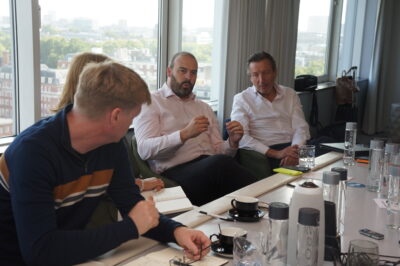
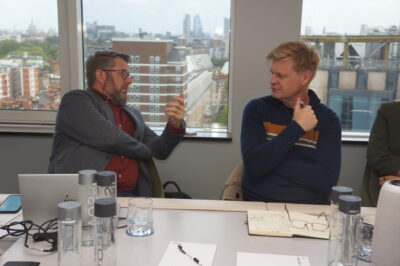
A recent roundtable brought together leaders from across the industry to explore the barriers, with the discussion revealing both optimism and deep-rooted challenges.
Defining the outcomes
A recurring theme was the absence of clear, measurable outcomes set by government. Without them, participants argued, industry cannot align investment or demonstrate progress.
Ron Lang reflected that too much effort has gone into promoting solutions, rather than asking the right questions. “If targets were set around labour efficiency or embodied carbon, industrialisation would follow naturally. But at the moment we’re neither setting expectations nor measuring progress and without that, change will stall.”
Keith Waller added that construction has become fixated on improving “pieces of the puzzle” rather than defining the bigger picture. Until a coherent national vision is established, he warned, the sector will only achieve incremental gains.
Pipelines without confidence
The debate quickly turned to the issue of project pipelines. Successive governments have promised visibility of future work, but the detail remains patchy.
For clients and contractors, this creates constant uncertainty. For SMEs, it is existential.
Too often they are invited to frameworks with the promise of opportunities that never materialise, leaving many “limping by,” as one participant described.
Emily King was clear that published pipelines lack the granularity needed: they rarely provide enough information for manufacturers to invest in people or facilities with confidence.
The group contrasted the UK’s fragmented pipeline with more coherent regional approaches.
Several argued that combined authorities, with devolved powers, may offer a better setting for industrialised programmes, smaller in scale but more tangible and deliverable.
A question of coordination
Several speakers suggested that client coordination, particularly within the public sector, has eroded over time.
During the post-war period, the state was able to deliver hundreds of thousands of homes and schools annually, albeit at varying levels of quality, because government acted as a capable, coordinated client.
Today, the picture is different. Frameworks are often used as a substitute for strategic planning, yet they are designed primarily to simplify administration rather than to secure value.
Richard Crosby noted that many frameworks fail to capture lessons learned or pass knowledge through the supply chain.
Instead, the sector finds itself competing within fragmented systems that add little certainty.
Procurement, risk and liability
Procurement practices remain a stubborn obstacle. Industrialised methods demand long-term relationships and consistency, yet public sector contracts often prioritise short-term price over collaboration.
Risk allocation is another sticking point. The desire to pass liability down the supply chain has left SMEs fragile and overexposed.
Emily explained that efforts to retain design liability at programme level could protect smaller suppliers, but the legal and contractual complexities remain daunting.
Crosby agreed, observing that risk management in construction too often means “transfer, rather than reduction,” creating fragility rather than resilience.
Measuring success
If government set clearer outcomes, the group argued, then measurement would follow naturally. Yet suitable metrics remain elusive.
Current data on productivity, for example, is blunt and misleading, lumping together productive sub-sectors such as civil engineering with weaker performers like general building.

Keith argued that more meaningful measures would resonate better with the public as well as policymakers: faster delivery, reduced vehicle movements, or fewer defects. “Those are the things communities care about,” he said.
The conversation also touched on the role of data and technology. Sam Stacey pointed to the potential of IoT and AI: by monitoring performance across programmes, he suggested, the industry could learn quickly and continuously improve.
But as Emily cautioned, statistics already tell a stark story: the number of SMEs going into administration while on public sector frameworks is a clear indicator that the system is struggling.
Leadership and accountability
Beyond procurement and pipelines lies a more fundamental challenge: leadership. Many participants lamented the lack of political accountability in the UK compared to other countries.
Sue Hine pointed to Ireland, where ministers must regularly report progress against housing and infrastructure targets.
That accountability, she said, forces action. By contrast, in the UK the construction portfolio is usually a small part of a minister’s brief, spread thinly across departments, with no clear centre of gravity.
Keith and others argued for a more senior champion of the built environment within government, someone with the authority to align health, education, housing and transport under a coherent strategy. Without that, fragmented responsibilities will continue to produce fragmented results.
Towards transformation
Despite the frustrations, the session closed with optimism. Asked what single “game changer” could drive industrialised construction forward, participants offered a range of answers.
For Emily, it was client and supplier co-creation: designing products, processes and even contract models together, rather than in isolation.
For Katie Rudin, it was clarity on affordable housing commitments, so that developers, housing associations and local authorities could all plan with certainty.
Trudi Sully emphasised the need for consensus: a shared understanding of definitions and priorities so the industry can speak with one voice.
Others focused on outcomes and measurement.
Ron called it “the single fundamental driver of change.” Mike Pitts urged a shift to procuring on performance, not promises.
And Richard pointed to the need to break from construction’s linear sequencing in favour of parallel processes that reduce time and cost.
A sector ready to scale
What united all perspectives was a conviction that industrialised construction is not a theoretical ambition but a practical necessity.
Skills shortages, climate targets and public demand for better outcomes will make traditional methods increasingly untenable.
As Darren Richards, chairing the discussion, summed up: “If we don’t get this right, no matter what we do with the nuts and bolts and the tech, it’s not going to happen.”
The jigsaw pieces, as Keith described them, are largely in place.
But without a clearer picture to guide the assembly, defined outcomes, coherent pipelines, smarter procurement and accountable leadership, the puzzle will remain unsolved.
Lessons learned
- Clarity of outcomes is missing – Without measurable government targets, such as reductions in carbon, improvements in labour efficiency or faster delivery, industry cannot align investment or demonstrate progress. Participants warned that the focus has been on promoting solutions rather than defining the problems outcomes should solve.
- Pipelines lack confidence and detail – Promised visibility of future work remains patchy. For SMEs in particular, frameworks often create false expectations, leaving businesses unable to invest. Regional or devolved programmes were seen as more tangible models than fragmented national pipelines.
- Client coordination has diminished – Where post-war government once acted as a coordinated client, today frameworks often substitute for strategy. Knowledge transfer is poor and fragmentation prevails.
- Procurement and risk remain barriers – Current practices prioritise short-term price and transfer liability down the supply chain, leaving SMEs vulnerable. Industrialised approaches require long-term relationships and fairer risk allocation.
- Measurement must reflect real outcomes – Blunt national productivity data obscures progress. Metrics such as reduced defects, fewer vehicle movements and faster delivery would resonate more with communities and policymakers alike. Digital technologies could enable better monitoring, but current statistics already show distress, especially among SMEs.
- Leadership and accountability are absent – Unlike countries where ministers report against housing or infrastructure targets, the UK disperses responsibility. Participants called for a senior champion to unite health, education, housing and transport under a coherent strategy.